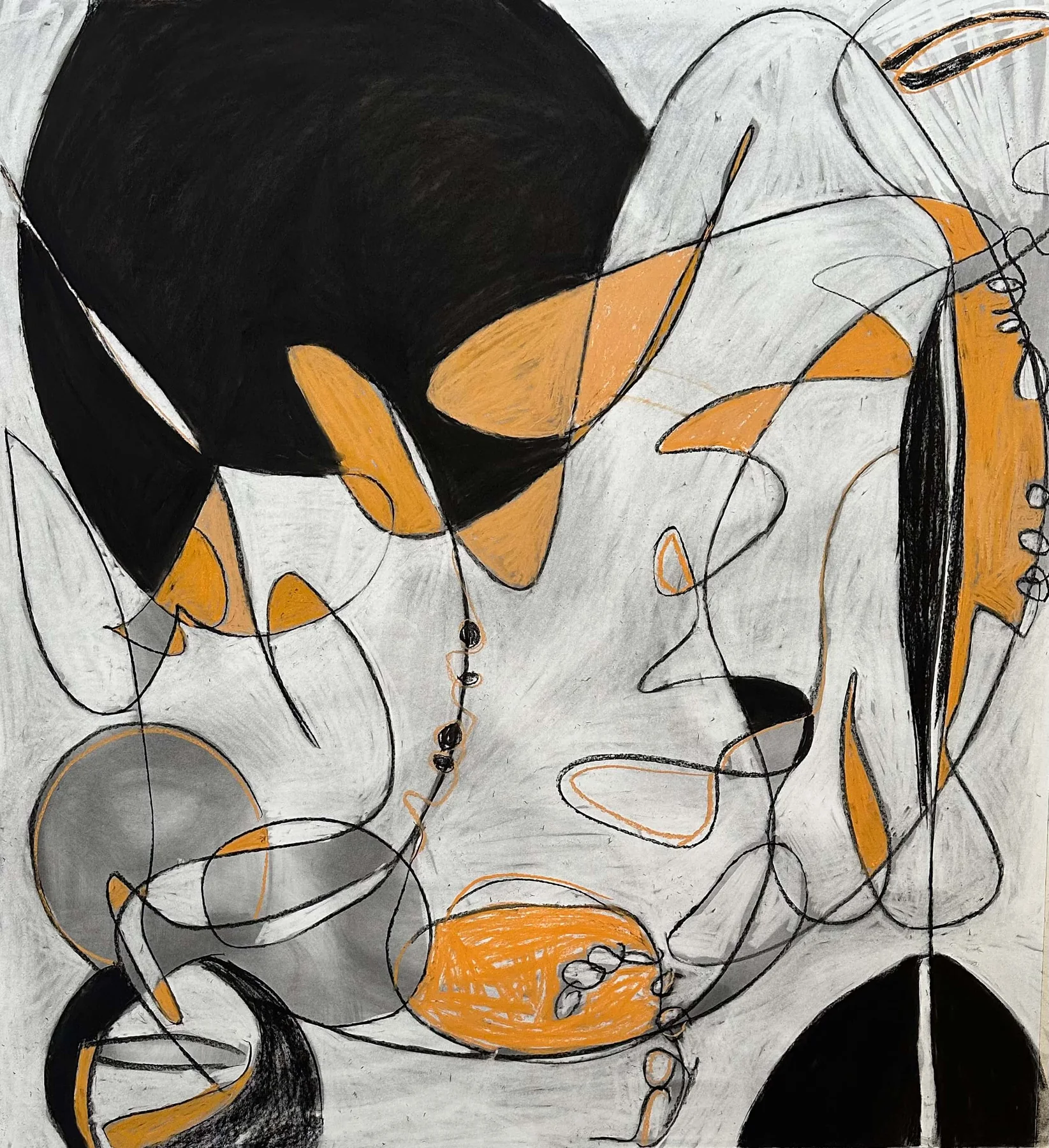
A gesture in art is both an action and a record. The line that remains on paper preserves speed, pressure, reach, rhythm, and interruption. It tells us something happened, but it does not reduce that event to a literal narrative. We encounter evidence of the body in motion and complete the experience through our own perception.
Charcoal and conté crayon are especially responsive to physical energy. They can produce a delicate trace or a dense, resistant field; they can be dragged, erased, rubbed, and redrawn. Every correction remains part of the work’s memory. The surface becomes an accumulation of attempts rather than a polished statement detached from its making.
Gesture also holds psychological time. Repeated marks can suggest insistence or care. A sudden break may feel like hesitation. A sweeping curve can gather multiple areas of a composition into one breath. These impressions are not fixed meanings, but they help explain why abstract drawing can feel emotionally specific even when it represents no identifiable object.
Viewers can read gesture by slowing down enough to imagine its making. Where might the artist have begun? Which marks sit on top and which disappear beneath others? Where does the hand seem controlled, and where does it accept uncertainty? The drawing then becomes a meeting between two bodies: the one that made the mark and the one now following it.