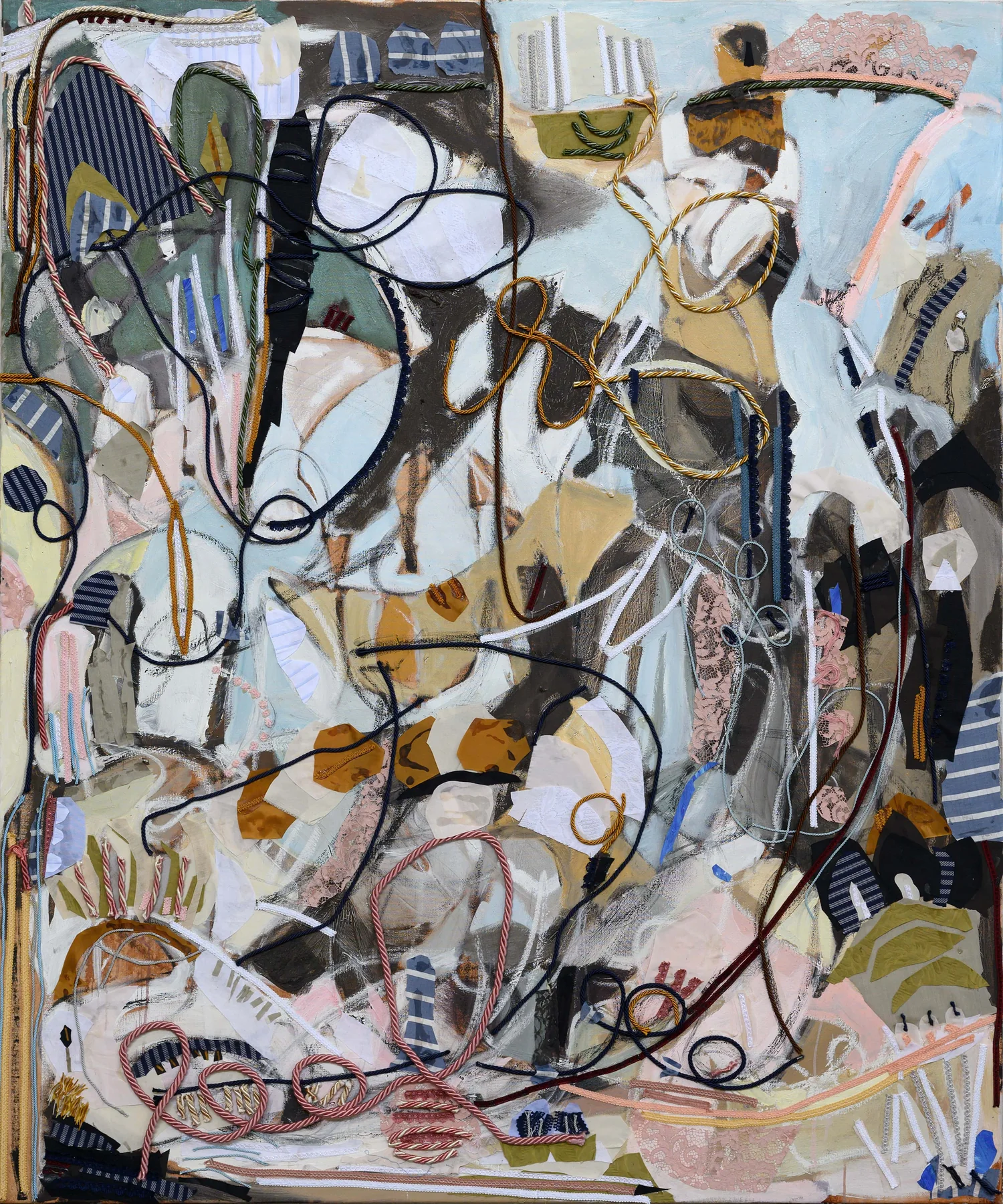
A fold draws without leaving a conventional mark. It redirects a surface, creates a ridge, and introduces a changing boundary between light and shade. Unlike a line applied to cloth, it is inseparable from the material’s position. The structure of the object becomes part of its graphic language.
Folds can also introduce different kinds of movement. A long crease may draw attention steadily across a field, while a compressed cluster produces interruption and density. Paint passing over these forms encounters peaks and recesses, allowing the same gesture to register unevenly across the surface.
Follow one fold as though it were a drawn line. Where does it begin to gather force, and where does it relax? Notice how its direction relates to painted marks nearby. The comparison reveals how fabric can participate in composition through its own behavior, contributing a vocabulary that is neither simply sculptural nor simply pictorial.